

Every year, investors sell their losing positions before the tax year ends, to book the losses against their gains. It’s selling with no view on the company, just a deadline. And that creates some of the best entries of the year for those of us on the other side, waiting for opportunities.
How it works
Who gets hit: the year’s worst performers, small caps and juniors most of all. Big, liquid stocks, they barely notice this volume.
When it peaks: in the last weeks before the tax year ends, running right up to the deadline, prices may bottom before that.
When it lifts: once the deadline passes, the forced selling simply stops. That gap is often where the rebound starts.
The follow-through: in countries with a wash-sale rule, sellers who want back in have to wait 30 days, which may add some buying later in the month. The evidence for this is thinner than for the rebound itself.
The calendar, by country
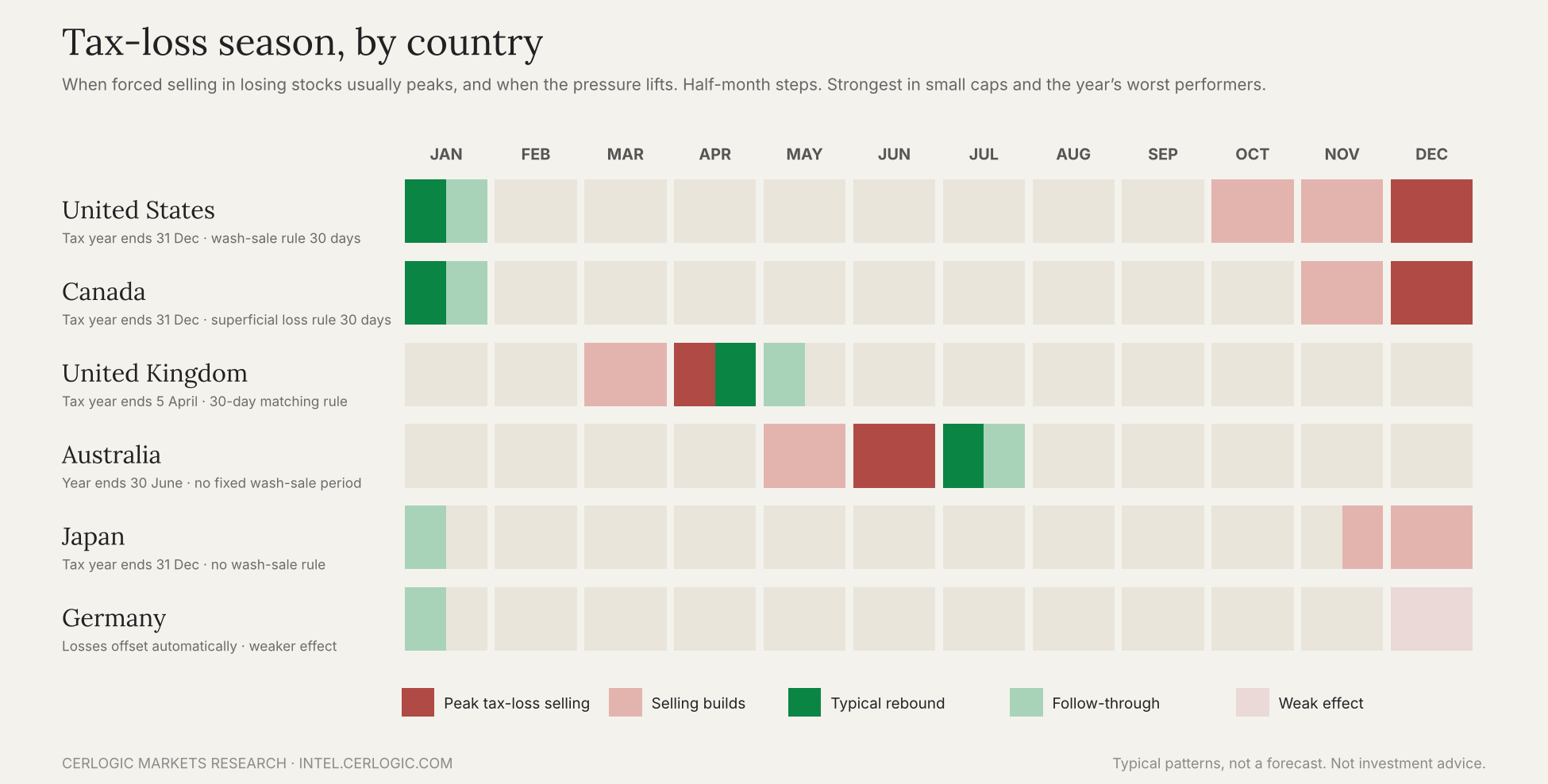
United States: tax year ends 31 December, and the trade date counts, so a sale on 31 December still lands in this year. Selling builds from October, because many mutual funds measure the gains they must distribute over the 12 months to 31 October. It continues through November and peaks in December, running into the last days of the year. Under the wash-sale rule, buying the same or a substantially identical security within 30 days before or after the sale defers the loss.
Canada: tax year ends 31 December, but trades must settle in the year. With next-day settlement, the last day to sell for 2026 is around 30 December. The superficial loss rule also covers 30 days before and after the sale. Tax-loss selling in Canadian juniors on the TSX and TSX-V is closely watched every December.
United Kingdom: tax year ends 5 April, so the selling comes in March and early April. Under the 30-day matching rule, buying back the same shares within 30 days after the sale matches them to that sale, so the loss can’t be booked that way.
Australia: the financial year ends 30 June, so selling peaks in June, with the rebound in July. There’s no fixed 30-day rule, but the tax office can deny losses from sales that are only for tax purposes.
Japan: tax year ends 31 December, and the last trading day for the tax year comes a few days earlier because of settlement. There’s no US-style wash-sale rule, so investors commonly sell and buy back, typically the next day or with a margin cross trade, which softens the price pressure.
Germany: the bank nets gains and losses automatically and carries unused stock losses into the next year, and stock losses only offset stock gains. So there’s little rush to sell before year-end, and the effect is weak.
How we plan to take advantage
Trading for rebound, in our favorite sectors: uranium, precious metals, platinum and palladium, royalty and streaming companies, copper and base metals juniors, energy services, and fertilizer and agriculture. That’s where tax-loss selling tends to bite hardest, and where we know the names best.
The Compounder portfolio: for companies we want to own for years, ideally forever, the best prices often come in the second half of December, at the height of the selling and before the January rebound. We’ll be allocating there, from our watchlist, in tranches. The candidates come from businesses that can compound for decades: a real moat, pricing power, revenue that keeps coming back, and earnings that rise with inflation. Already scored are share cannibals, royalty and streaming, capital markets, medical devices, utilities, LNG, and fertilizers.
